If you are asking what makes a home a true estate in Holmby Hills, square footage alone will not give you the answer. In this part of Los Angeles, estate status is tied to land, privacy, architectural pedigree, and the way a property sits on its site. Whether you are buying, selling, or simply trying to understand the neighborhood at a higher level, it helps to know what separates a large luxury house from an actual estate. Let’s dive in.
Estate roots matter in Holmby Hills
Holmby Hills was planned from the start as an estate district. According to the LA Conservancy record on the area’s development history, the neighborhood was developed in 1925 by Arthur Letts and the Janss Investment Company on 400 acres of the former Wolfskill Ranch, with underground utilities, ornamental street lamps, paved concrete streets, parks, and bridle trails.
That original vision still shapes how buyers and sellers define value today. By the 1960s, most of Holmby Hills had been built out with large single-family residences, and the neighborhood’s identity remained tied to an estate-style pattern rather than a conventional suburban one.
It is also important to know that Holmby Hills spans both the Bel Air-Beverly Crest and Westwood community plan areas. As a result, parcel-level conditions can vary by address, which is one reason estate analysis here needs to be property-specific.
Land defines the estate experience
In Holmby Hills, a true estate is usually defined by what the land can support. The broader historic survey of westside estate districts notes that many custom houses were built on several acres and often included guest and pool houses, tennis courts, swimming pools, extensive gardens, and separate service quarters, as described in the Bel Air-Beverly Crest historic survey report.
That means the lot must do more than hold a large residence. It should have enough depth and width to create meaningful grounds, separate accessory structures, and an arrival sequence that feels private and intentional.
In practical terms, buyers often recognize estate quality through features like:
- Deep setbacks from the street
- Broad frontage with strong visual buffering
- Gates, hedging, or layered landscaping
- A long private drive or formal approach
- Space for guest, recreation, or staff uses beyond the main house
Frontage and approach set the tone
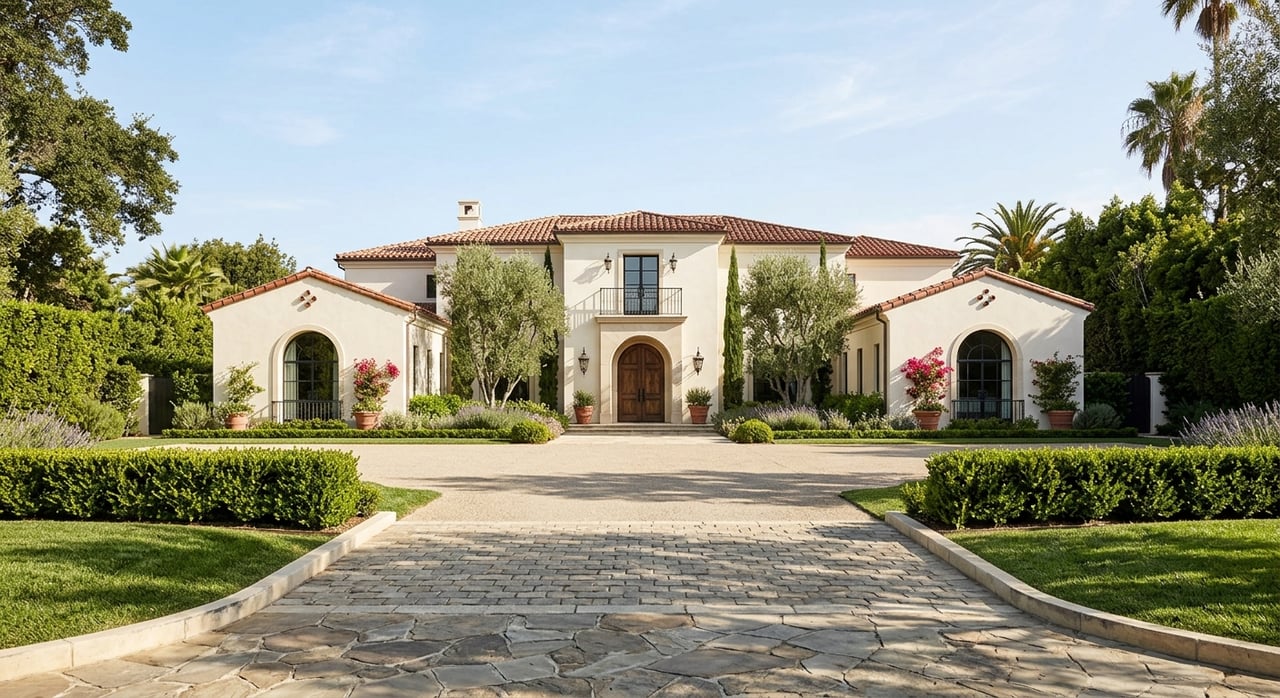
One of the clearest differences between a luxury home and a true estate is how you arrive. In Holmby Hills, the frontage expectation is formal, not suburban. The relationship between street and residence matters because established setback lines in mature Westwood areas reinforce a composed, street-to-house presentation.
A true estate tends to conceal movement rather than display it. Cars, service access, and day-to-day activity are typically pushed out of sight so the property reads as calm, private, and self-contained.
Current high-end examples reflect that model. The research record cites a recent Holmby Hills property entered by a 226-foot drive, while another major estate was described as hidden on 10 acres with a guest house, staff housing, a tennis court, and an Olympic-size pool.
Architecture carries real weight
In Holmby Hills, architectural pedigree matters. The neighborhood was designed to attract notable architects and landscape architects, and the historic record names George Washington Smith, Wallace Neff, Paul Williams, Gordon Kaufmann, Roland E. Coate, and John Byers among those associated with its early development. The tradition continued after World War II with figures including Richard Neutra, Lloyd Wright, and Raphael Soriano, according to the historic survey report.
This is why estate status is not only about scale. A residence with important authorship, an original landscape concept, and strong period integrity can carry estate-level significance even if it is not the biggest structure on the street.
The LA Conservancy’s preservation commentary on Holmby-Westwood reinforces that point, describing the area as one of the city’s premier historic neighborhoods with extraordinary residential architecture from the 1920s through the 1950s.
Grounds matter as much as interiors
A true Holmby Hills estate is usually experienced as a compound, not just a house. Historical patterns and current luxury offerings both show that buyers expect a broader program of spaces that support entertaining, privacy, and long-term use.
That can include:
- Guest houses
- Pool houses
- Staff quarters
- Tennis courts
- Formal gardens
- Motor courts
- Gyms
- Theaters
- Outdoor kitchens
- Resort-style pools
This matters because estate buyers are often evaluating function across the entire property. They may care less about raw bedroom count and more about whether the home supports hosting, multigenerational living, privacy, and day-to-day flexibility.
Preservation and integrity still influence value
Holmby Hills has strong historic identity, but not every property is protected in the same way. Preservation advocates have described Holmby-Westwood as one of Los Angeles’ premier historic neighborhoods, yet the proposed HPOZ effort was halted in 2016, as noted by the LA Conservancy.
For sellers, that means estate character can be highly valued even without a single neighborhood-wide overlay. For buyers, it means diligence matters. Design integrity, site planning, alterations, and parcel-specific planning context can all affect how a property is perceived in the market.
Pricing metrics can miss the point
Holmby Hills is a thin market, so broad price metrics should be read carefully. The research report notes that Redfin’s Holmby Hills housing data showed a February 2026 median sale price of $6.9 million based on one sale and 186 median days on market, while a separate March 2026 neighborhood summary cited 14 active listings and a median listing price of $3.845 million.
With numbers that limited, median pricing is directional rather than definitive. In an estate submarket like Holmby Hills, price per square foot is also a blunt tool because it rarely captures acreage, architectural authorship, privacy, or the quality of grounds.
When a property has provenance, a meaningful site, and a strong compound program, its value may sit well outside what simpler metrics suggest. That is why estate-level pricing is usually judged through a more tailored lens.
Estate marketing is often private
A true estate in Holmby Hills is often marketed differently from a typical luxury listing. The California Association of Realtors defines a pocket listing as a property marketed within an agent’s own network rather than on the MLS, and the National Association of Realtors notes that sellers may choose privacy-driven alternatives such as delayed marketing exempt listings or office exclusives, as summarized in the CAR guidance on pocket listings.
That approach makes sense in Holmby Hills, where privacy, architecture, and provenance can matter more than broad internet exposure. In some cases, a seller may benefit from curated buyer outreach, controlled public visibility, and a presentation strategy that protects both the home and the owner.
For buyers, this also means some opportunities may surface through relationships and private networks rather than through standard public search channels. In an inventory-constrained market, access and discretion can be as important as timing.
What truly defines an estate
So, what defines a true estate in Holmby Hills? It is usually the combination of several factors working together, not one headline number.
A true estate in this neighborhood often includes:
- Land substantial enough for a main residence and meaningful grounds
- A long or buffered approach that creates privacy
- Formal frontage with deep setbacks and hidden service circulation
- Architectural or landscape pedigree, or both
- Accessory structures and amenities that create compound-like living
- A sense of integrity between house, site, and neighborhood context
In other words, a true estate feels composed, private, and complete. It reads as a property with presence, not simply a house with a high square-foot count.
If you are preparing to sell or evaluating a potential purchase in Holmby Hills, that distinction matters. Estate value here is often built on nuance, and the strongest outcomes usually come from understanding how land, architecture, privacy, and market strategy intersect.
If you would like a discreet conversation about estate positioning, valuation, or buyer opportunities in Holmby Hills, connect with Joe Babajian for a private consultation.
FAQs
What defines a true estate in Holmby Hills?
- A true estate in Holmby Hills is typically defined by land, privacy, formal approach, architectural pedigree, meaningful grounds, and compound-style functionality rather than square footage alone.
Why is lot size not the only factor for a Holmby Hills estate?
- Lot size matters, but estate status also depends on whether the site can support deep setbacks, a private arrival sequence, accessory buildings, and a cohesive relationship between the residence and its grounds.
Why does architecture matter in Holmby Hills real estate?
- Architecture matters because Holmby Hills has a strong history of notable architects and landscape designers, and homes with important authorship and intact character often carry added estate-level significance.
How are Holmby Hills estates usually marketed?
- Holmby Hills estates are often marketed with a more private strategy that may include curated outreach, office exclusives, or other controlled exposure methods when privacy and provenance are priorities.
Why can pricing a Holmby Hills estate be complex?
- Pricing can be complex because inventory is limited and standard metrics like median sales price or price per square foot may not fully reflect acreage, design pedigree, privacy, or the quality of the grounds.